Showing posts with label Constellations. Show all posts

Thursday, April 23, 2009

Crater


Crater is a constellation. Its name is Latin for cup, and in Greek mythology it is identified with the cup of the god Apollo. It was one of the 48 constellations listed by the 1st century astronomer Ptolemy, and remains one of the 88 modern constellations. It is faint, with no star brighter than fourth magnitude.

Deep sky objects

NGC 3511 is a spiral galaxy with a slight bar, seen nearly from the edge, of type SBbc. It is a member of the galaxy cluster Abell 1060. This galaxy is magnitude 12, and is 4' × 1' in size.
NGC 3887 is a barred-spiral of type SBc, magnitude 11, with a diameter of 3.5'.
NGC 3981 is a spiral galaxy with two wide spiral arms, of type SBbc. It is magnitude 12 with a diameter of 3'. This galaxy was discovered by William Herschel in 1785.

Mythology

Crater is identified with a story from Greek mythology in which a crow or raven serves Apollo, and is sent to fetch water, but it rests lazily on the journey, and after finally obtaining the water in a cup, takes back a water snake as well, as an excuse. According to the myth, Apollo saw through the fraud, and angrily cast the crow, cup, and snake, into the sky. The constellations of Corvus the crow and Hydra the water-snake are also identified with this myth.

http://en.wikipedia.org/wiki/Crater_(constellation)

Chamaeleon


Chamaeleon is a small constellation in the southern sky. It is named after the chameleon, a form of lizard. It was first defined in the sixteenth century. In Australia it is sometimes unofficially called "the Frying Pan" when finding the south by the stars.

History

Chamaeleon was one of twelve constellations created by Petrus Plancius from the observations of Pieter Dirkszoon Keyser and Frederick de Houtman. It first appeared on a 35-cm diameter celestial globe published in 1597 (or 1598) in Amsterdam by Plancius and Jodocus Hondius. The first depiction of this constellation in a celestial atlas was in Johann Bayer's Uranometria of 1603.

Notable features

In 1999, a nearby open cluster was discovered centered on the star η Chamaeleontis. The cluster, known as either the Eta Chamaeleontis cluster or Mamajek 1, is 8 million years old, and lies 316 light years from Earth.

The constellation contains a number of molecular clouds (the Chamaeleon dark clouds) that are forming low-mass T Tauri stars. The cloud complex lies some 400 to 600 light years from Earth, and contains tens of thousands of solar masses of gas and dust. The most prominent cluster of T Tauri stars and young B-type stars are in the Chamaeleon I cloud, and are associated with the reflection nebula IC 2631.

http://en.wikipedia.org/wiki/Chamaeleon

Antlia


Antlia from Ancient Greek is a constellation in the southern sky. Its name means "pump" and it specifically represents an air pump. The stars comprising Antlia are faint, and the constellation was not created until the eighteenth century. Beginning at the north, Antlia is bordered by Hydra the sea snake, Pyxis the compass, Vela the sails, and Centaurus the centaur.

History

Antlia was created by the French astronomer Abbé Nicolas Louis de Lacaille, who created fourteen constellations for the southern sky to fill some faint regions. It was originally denominated Antlia pneumatica to commemorate the air pump invented by the French physicist Denis Papin. The International Astronomical Union subsequently adopted it as one of the 88 modern constellations. There is no mythology attached to Antlia as Lacaille discontinued the tradition of giving names from mythology to constellations and instead chose names mostly from scientific instruments. This constellation has not 3, but 4 main stars.

Notable features

Antlia is devoid of bright stars. The brightest star is α Antliae, a magnitude 4.25m orange giant. Antlia contains the following deep sky objects:

NGC 2997, a spiral galaxy of type Sc which is inclined 45° to our line of sight.
NGC 3132, a planetary nebula, also called the Eight-burst Nebula or Southern Ring Nebula. At its heart is a binary star system.
The Antlia Dwarf, a 14.8m dwarf spheroidal galaxy that belongs to our Local Group of galaxies. It was discovered only as recently as 1997.

http://en.wikipedia.org/wiki/Antlia

Wednesday, April 15, 2009

Volans


Volans is a constellation in the southern sky. It represents a flying fish; its name is a shortened form of its original name, Piscis Volans. Volans was one of twelve constellations created by Petrus Plancius from the observations of Pieter Dirkszoon Keyser and Frederick de Houtman and it first appeared on a 35-cm diameter celestial globe published in 1597 (or 1598) in Amsterdam by Plancius with Jodocus Hondius. The first depiction of this constellation in a celestial atlas was in Johann Bayer's Uranometria of 1603.

http://en.wikipedia.org/wiki/Volans

Saturday, March 28, 2009

Vela


Vela is a constellation in the southern sky. Its name is Latin for the sails of a ship, and it was originally part of a larger constellation, the ship Argo Navis, which was later divided into three parts, the others being Carina and Puppis.

Stars

The brightest star in the constellation, γ Velorum, is a bright 1.75m supergiant star. The star is actually quintuple, the primary component is famous for being the brightest Wolf-Rayet star in the sky. This star is also sometimes called Regor, which is Roger backwards.

Deep sky objects

Of the deep sky objects of interest in Vela is a planetary nebula known as the NGC 3132 (nicknamed Eight-burst nebula). Also of interest within the constellation is the Vela Supernova Remnant. This is the nebula of a supernova explosion which is believed to have been visible from the Earth around 10,000 years ago. The remnant contains a pulsar which was the first pulsar to be identified optically.

The Gum Nebula is a faint emission nebula, believed to be the remains of a million year old supernova.

http://en.wikipedia.org/wiki/Vela_(constellation)

Pyxis


Pyxis is a small and faint constellation in the southern sky. Its name is Latin for a mariner's compass (it should not be confused with Circinus, which represents a draftsman's compasses). Pyxis is completely visible in latitudes south of 53 degrees north from January through March.

Pyxis was introduced by Nicolas Louis de Lacaille in the eighteenth century; he called it Pyxis Nautica, but the name was shortened. The constellation is located close to those forming the old constellation of Argo Navis (the ship Argo), and in the nineteenth century astronomer John Herschel suggested renaming Pyxis to 'Malus, the mast', but the suggestion was not followed.

http://en.wikipedia.org/wiki/Pyxis

Saturday, March 21, 2009

Puppis


Puppis is a constellation in the southern sky. Its name is Latin for the poop deck of a ship, and it was originally part of a larger constellation, the ship Argo Navis, which was later divided into three parts, the others being Carina and Vela; Puppis is the largest of the three.

Planetary systems

Several extrasolar planet systems have been found around stars in the constellation Puppis.

On July 1, 2003, a planet was found orbiting the star HD 70642. This planetary system is much like Jupiter with a wide, circular orbit and a long-period.

On May 17, 2006, HD 69830 (the nearest star of this constellation) was discovered to have three Neptune-mass planets, the first multi-planetary system without any Jupiter-like or Saturn-like planets. The star also hosts an asteroid belt at the region between middle planet to outer planet.

On June 21, 2007, the first extrasolar planet found in the open cluster NGC 2423, was discovered around the red giant star NGC 2423-3. The planet is at least 10.6 times the mass of Jupiter and orbits at 2.1 AU distance.

On September 22, 2008, two Jupiter-like planets were discovered around HD 60532. HD 60532 b has a minimum mass of 1.03 MJ and orbits at 0.759 AU and takes 201.3 days to complete the orbit. HD 60532 c has a minimum mass of 2.46 MJ and orbits at 1.58 AU and takes 604 days to complete the orbit.

Deep sky objects

As the Milky Way runs through Puppis, there are a large number of open clusters in the constellation. Messier 46 (M46) and Messier 47 (M47) are two open clusters in the same binocular field. M47 can be seen with the naked eye under dark skies, and its brightest stars are 6th magnitude. Messier 93 (M93) is another open cluster somewhat to the south. NGC 2451 is a very bright open cluster containing the star c Puppis.

http://en.wikipedia.org/wiki/Puppis

Thursday, March 12, 2009

Lynx


Lynx is a constellation in the northern hemisphere's sky, introduced in the 17th century by Johannes Hevelius. It is named after the lynx, a genus of cat. It is a very faint constellation; its brighest stars from a zigzag line.

History

Johannes Hevelius defined the constellation in the 17th century because he wanted to fill the open gap between the constellations Ursa Major and Auriga. He supposedly named it Lynx because of its faintness; only the lynx-eyed (or those of good sight) would have been able to recognise it.

Notable features

The star 31 Lyncis, or κ Lyn, is also known as Alsciaukat (from the Arabic for the thorn), is the only named star in this constellation.

Lynx's most notable deep sky object is the Intergalactic Tramp NGC 2419, a globular cluster that is the most distant known of its kind. It is moving faster than escape velocity at that distance; however, it appears to be in a long elliptical orbit around our galaxy, the Milky Way, and is thus not expected to escape. [The two facts in the previous sentence are contradictory: escape velocity means the velocity at which it will escape.] It also contains, nearly at the border with Cancer, the galaxy NGC 2683.

http://en.wikipedia.org/wiki/Lynx_(constellation)

Carina


Carina is a constellation in the southern sky. Its name is Latin for the keel of a ship, and it was formerly part of the larger constellation of Argo Navis (the ship Argo) until that constellation was divided in three.

Notable features

Carina contains Canopus, the second brightest star in the night sky, and the supermassive star η Carinae which is embedded in the giant Eta Carinae Nebula (NGC 3372).

Since the Milky Way runs through Carina, there are a large number of open clusters in the constellation. These include NGC 2516 and IC 2602, the latter popularly known as the "Southern Pleiades." The most notable object in Carina is Homunculus Nebula in NGC 3372, the Eta Carinae Nebula. It is a planetary nebula visible to the naked eye that is being ejected by the erratic variable star Eta Carinae, one of the Milky Way's largest stars and one not far from becoming a supernova. NGC 3532 is a large binocular cluster having about 150 stars. Carina also contains the naked-eye globular cluster NGC 2808. Epsilon Carinae and Upsilon Carinae are double stars visible in small telescopes.

Carina contains the radiant of the Eta Carinids meteor shower, which peaks around January 21 each year.

http://en.wikipedia.org/wiki/Carina_(constellation)

Canis Minor


Canis Minor is a small constellation. It was included in the 1st century astronomer Ptolemy's 48 constellations, and is still included among the 88 modern constellations. Its name is Latin for "smaller dog" in contrast to Canis Major, the larger dog, and it is commonly represented as one of the dogs following the constellation of Orion the hunter.

Canis Minor is a small constellation containing only two bright stars, Procyon (α CMi, 0.38m) and Gomeisa (β CMi , 2.9m). Procyon is the eighth brightest star in the night sky. Procyon means "before the dog" in Greek, as it rises an hour before the 'Dog Star', Sirius, of Canis Major.

Canis Minor has no deep sky object brighter than magnitude 15.

History and mythology

The ancient Greeks did not recognise Canis Minor it as a distinct constellation, and considered Orion to have had one dog, Canis Major.[citation needed]

Canis Minor is sometimes connected with the Teumessian Fox, beast turned into stone with its hunter, Laelaps, by Zeus, who placed them in heaven as Canis Major (Laelaps) and Canis Minor (Teumessian Fox).

http://en.wikipedia.org/wiki/Canis_Minor

Saturday, March 7, 2009

Cancer


Cancer is one of the twelve constellations of the zodiac. Its name is Latin for crab and it is commonly represented as such. Its symbol is (Unicode ♋). Cancer is small and its stars are faint. It lies between Gemini to the west and Leo to the east, Lynx to the north and Canis Minor and Hydra to the south.

Planetary system

Cancri is a quintruple planet system with four gas giants and one terrestrial planet.

Deep sky objects

Cancer is the best noted among stargazers as the home of Praesepe (Messier 44), an open cluster also called the Beehive Cluster or the Gate of Men, which contains the star ε Cancri. The smaller, denser open cluster Messier 67 can also be found here.

Mythology

Cancer the crab, plays a minor role in the Twelve Labors of Hercules. While Hercules was busy fighting the multi-headed monster, Hydra, the goddess Hera, who did not like Hercules, sent the Crab to distract him. Cancer grabbed onto the hero's toe with its claws, but barely breaking the rhythm of his great battle with Hydra, Hercules crushed the crab with his foot. Hera, grateful for the little crustacean's heroic but pitiful effort, gave it a place in the sky.

Cancer is said to have been the place for the Akkadian Sun of the South, perhaps from its position at the winter solstice in very remote antiquity. But afterwards it was associated with the fourth month Duzu (June-July in the modern western calendar), and was known as the Northern Gate of Sun.[citation needed]

Showing but few stars, and its brightest stars being of only 4th magnitude, Cancer was often considered the "Dark Sign", quaintly described as black and without eyes. Dante, alluding to this faintness and position of heavens, wrote in Paradiso:

Then a light among them brightened,
So that, if Cancer one such crystal had,
Winter would have a month of one sole day.

Pictor


Pictor is a small and faint constellation in the southern sky (declination −50° to −60°), located between the brilliant star Canopus and the Large Magellanic Cloud. Its name is Latin for painter, but it is in fact an abbreviation of its original name Equuleus Pictoris, the 'painter's easel', and it is normally represented as an easel. It was invented and named by Abbé Nicolas Louis de Lacaille in the 17th century.

Pictor has attracted attention in recent years because of its second-brightest star β Pictoris, 62.9 light-years distant, which is surrounded by an unusual dust disk rich in carbon. Kapteyn's Star, a nearby red dwarf at the distance of 12.78 light years, is the closest halo star known.

http://en.wikipedia.org/wiki/Pictor

Sunday, March 1, 2009

Monoceros


Monoceros is a faint constellation in the northern sky. Its name is Greek for unicorn. Its creation is attributed to the 17th-century Dutch cartographer Petrus Plancius. It is bordered by Orion to the west, Gemini to the north, Canis Major to the south and Hydra to the east. Other bordering constellations include Canis Minor, Lepus and Puppis.

Notable features
Monoceros is a constellation that is not very easily seen with the naked eye, with only a few fourth magnitude stars. Alpha Monocerotis has a visual magnitude of 3.93, slightly brighter than Gamma Monocerotis, which has a visual magnitude of 3.98.

However, Monoceros does have some interesting features to observe with the aid of a small telescope. Beta Monocerotis is an impressive triple star system, the three stars forming a triangle which seems to be fixed. The visual magnitudes of the stars are 4.7, 5.2 and 6.1. William Herschel discovered it in 1781 and commented that it is "one of the most beautiful sights in the heavens".

Epsilon Monocerotis is a fixed binary, with visual magnitudes of 4.5 and 6.5.

S Monocerotis, or 15 Monocerotis, is a bluish white variable star and is located at the center of NGC 2264. However, the variation of its magnitude is not too great. It has a companion star of visual magnitude 8.

V838 Monocerotis had an outburst starting on January 6, 2002.

Monoceros also contains Plaskett's Star, which is a massive binary system whose combined mass is estimated to be that of almost 100 Suns put together.

History
Monoceros is a relatively modern constellation. Its first certain appearance is on a globe created by the Dutch cartographer Petrus Plancius in 1612 or 1613, and was later charted by Jakob Bartsch as Unicornus in his star chart of 1624. Heinrich Wilhelm Olbers and Ludwig Ideler indicate the constellation may be older, quoting an astrological work from 1564 that mentioned "the second horse between the Twins and the Crab has many stars, but not very bright"; these references may ultimately be due to Michael Scot of the 13th century, but refer to a horse and not a unicorn, and its position does not quite match. Joseph Scaliger is reported to have found Monoceros on an ancient Persian sphere.

Lepus


Lepus is a constellation lying just south of the celestial equator. Its name is Latin for hare. Lepus was one of the 48 constellations listed by the 1st century astronomer Ptolemy, and it remains one of the 88 modern constellations. It is located below the constellation Orion (the hunter), and is sometimes represented as a hare being chased by Orion.

This constellation should not be confused with Lupus, the wolf.

Gemini


Gemini is one of the constellations of the zodiac. Its name is Latin for "twins", and it is associated with the twins Castor and Pollux in Greek mythology. Its symbol is (Unicode ♊). It lies between Taurus to the west and the dim Cancer to the east, with Auriga and Lynx to the north and Monoceros and Canis Minor to the south.

Notable features
Gemini includes the Open Cluster M35. NGC 2158 is just southeast of M35. Also of note is the unique Eskimo Nebula, (also known as the Clownface Nebula) just southeast of the NGC 2420 open star cluster. Far northeast of this cluster lies NGC 2371, a planetary nebula next to the Gemini twin on the right. Another popular nebula in Gemini lies in the southern tip of the constellation, Abell 21 the Medusa Nebula.

Visualizations
Gemini is dominated by Castor and Pollux, two bright stars that appear relatively close together, encouraging the mythological link between the constellation and twinship. The twin to the right is Castor, whose brightest star is α Geminorum (more commonly called Castor), is of the second magnitude, and represents Castor's head. The twin to the left is Pollux, whose brightest star is β Geminorum (more commonly called Pollux), is of the first magnitude, and represents Pollux's head. Furthermore, the other stars can be visualized as two parallel lines descending from the two main stars, making it look like two figures.

Mythology
Gemini was associated with the myth of Castor and Pollux, collectively known as the Dioscuri. One myth of these twins concerns cattle theft, and may be connected to early myths that described the Milky Way as a herd of dairy cows. On star maps, the twins are usually viewed as leaning away from the Milky Way, but are sometimes depicted with one of the twins residing in the Milky Way, and the other outside it, a situation making it appear that one of the twins is stealing the cattle, and the other is observing. Along with the other features of the area in the Zodiac sign of Gemini (i.e. Orion, Auriga, and Canis Major), this may be the origin of the myth of the cattle of Geryon, which forms one of The Twelve Labours of Heracles

http://en.wikipedia.org/wiki/Gemini_(constellation)

Columba


Columba is a small, faint constellation created in the sixteenth century. Its name is Latin for dove. It is located just south of Canis Major and Lepus.

History
Columba was created by Dutch astronomer Petrus Plancius in 1592 in order to differentiate the 'unformed stars' of the large constellation Canis Major. Plancius first depicted Columba on the small celestial planispheres of his large wall map of 1592. It is also shown on his smaller world map of 1594 and on early Dutch celestial globes.

Plancius originally named the constellation Columba Noachi ("Noah's Dove"), referring to the dove that gave Noah the information that the Great Flood was receding. This name is found on early 17th-century celestial globes and star atlases (such as Bayer's Uranometria of 1603[1]).

Notable features
Columba is rather inconspicuous, the brightest star α Columbae having the magnitude of 2.65m. α Columbae is called Phact, which comes from Arabic Al-Fakhita (the dove). The only other named star is Beta, β, Columbae, which has the name Wazn or Wezn, from the Arabic for a weight.

The constellation contains the runaway star μ Columbae, which was probably expelled from the ι Orionis system.

Friday, February 6, 2009

Canis Major


Canis Major is a constellation included in the 1st century astronomer Ptolemy's 48 constellations, and still included among the 88 modern constellations. Its name is Latin for 'greater dog', and is commonly represented as one of the dogs following Orion the hunter (see also Canis Minor the 'lesser dog'). Canis Major contains Sirius, the brightest star in the night sky, known as the 'dog star'; that star is part of the asterism known as theWinter Triangle in the Northern Hemisphere, or the Summer Triangle in the Southern.

Mythology
In early classical Europe, Canis Major represented the dog Laelaps, a gift from Zeus to Europa; or sometimes the hound of Procis, Diana's nymph; or the one given by Aurora to Cephalus, so famed for its speed that Zeus elevated it to the sky.

It was also considered to represent Orion's hunting dog, pursuing Lepus the Hare or helping Orion fight Taurus the Bull; and is referred to in this way by Aratos, Homer and Hesiod. The ancient Greeks refer only to one dog, but by Roman times, Canis Minor appears as Orion's second dog.

Sirius was considered a dog in its own right, early Greek mythology sometimes the constellation to represent a two-headed dog. As such, together with the area of the sky that is deserted (now considered as the new and extremely faint constellations Camelopardalis and Lynx), and the other features of the area in the Zodiac sign of Gemini (i.e. the Milky Way, and the constellations Gemini, Orion, Auriga, and Canis Minor), this may be the origin of the myth of the cattle of Geryon, which forms one of The Twelve Labours of Heracles.

Roman myth refers to Canis Major as Custos Europae, the dog guarding Europa but failing to prevent her abduction by Jupiter in the form of a bull; and as Janitor Lethaeus, the watchdog.


Messier 41 (also known as M 41 or NGC 2287) is an open cluster in the Canis Major constellation. It was discovered by Giovanni Batista Hodierna before 1654 and was perhaps known to Aristotle about 32 BC. M 41 is lying about 4 degrees nearly exactly south of Sirius and contains about 100 stars. Among these are several red giants, the brightest being spectral type K3, and located near its center. The cluster is estimated to be moving away from us at 23.3 km/s. The diameter of the cluster is between 25 and 26 light years. Its age is estimated at between 190 and 240 million years old. M 41 may also be referred to as NGC 2287.

Camelopardalis


Camelopardalis, from Greek καμηλοπάρδαλις,(Greeks thought that it had the head of a camel and the spots of a leopard) is a large but faint constellation in the northern sky. Its name is Latin for giraffe. The constellation was first described by Jakob Bartsch in 1624, but was probably created earlier by Petrus Plancius. In older astronomy books, one will sometimes see an alternative spelling of the name as Camelopardus.

History
The faintness of the constellation, and that of the nearby constellation Lynx, lead to the early Greeks considering this area of the sky to be empty. Camelopardalis was not defined as a constellation until the seventeenth century and thus has no mythology associated with its stars.


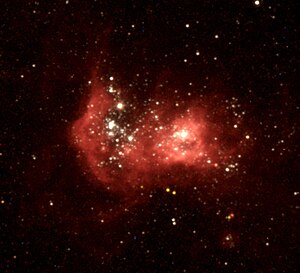
NGC 2363 in Camelopardalis


Thursday, February 5, 2009

Auriga


Auriga is a constellation in the northern sky. Its name is Latin for 'charioteer' and its stars form a shape that has been associated with the pointed helmet of a charioteer. It was one of the 48 constellations listed by the 1st century astronomer Ptolemy, and is included among the 88 modern constellations. Its brightest star is Capella.

Mythology
According to one Greek myth, Auriga represents Hephaestus, the blacksmith god, who was lame and invented the chariot so as to easily travel wherever he wanted.[citation needed] In another Greek myth, Auriga is said to represent Myrtilus, the charioteer of King Oenomaus, and who sabotaged the king's chariot.

Auriga might also represent the 10th Labour of Hercules. Together with the area of the sky that is deserted (now the new and extremely faint constellations Camelopardalis and Lynx), and the other features of the area in the Zodiac sign of Gemini (i.e. the Milky Way, and the constellations Gemini, Orion, and Canis Major), this may be the origin of the myth of the cattle of Geryon, which forms one of The Twelve Labours of Heracles. Capella is associated with the mythological she-goat Amalthea. It forms an asterism with the stars ζ Aurigae and η Aurigae, which are known as the Haedi (the Kids).


AE Aurigae and the Nebula IC 405